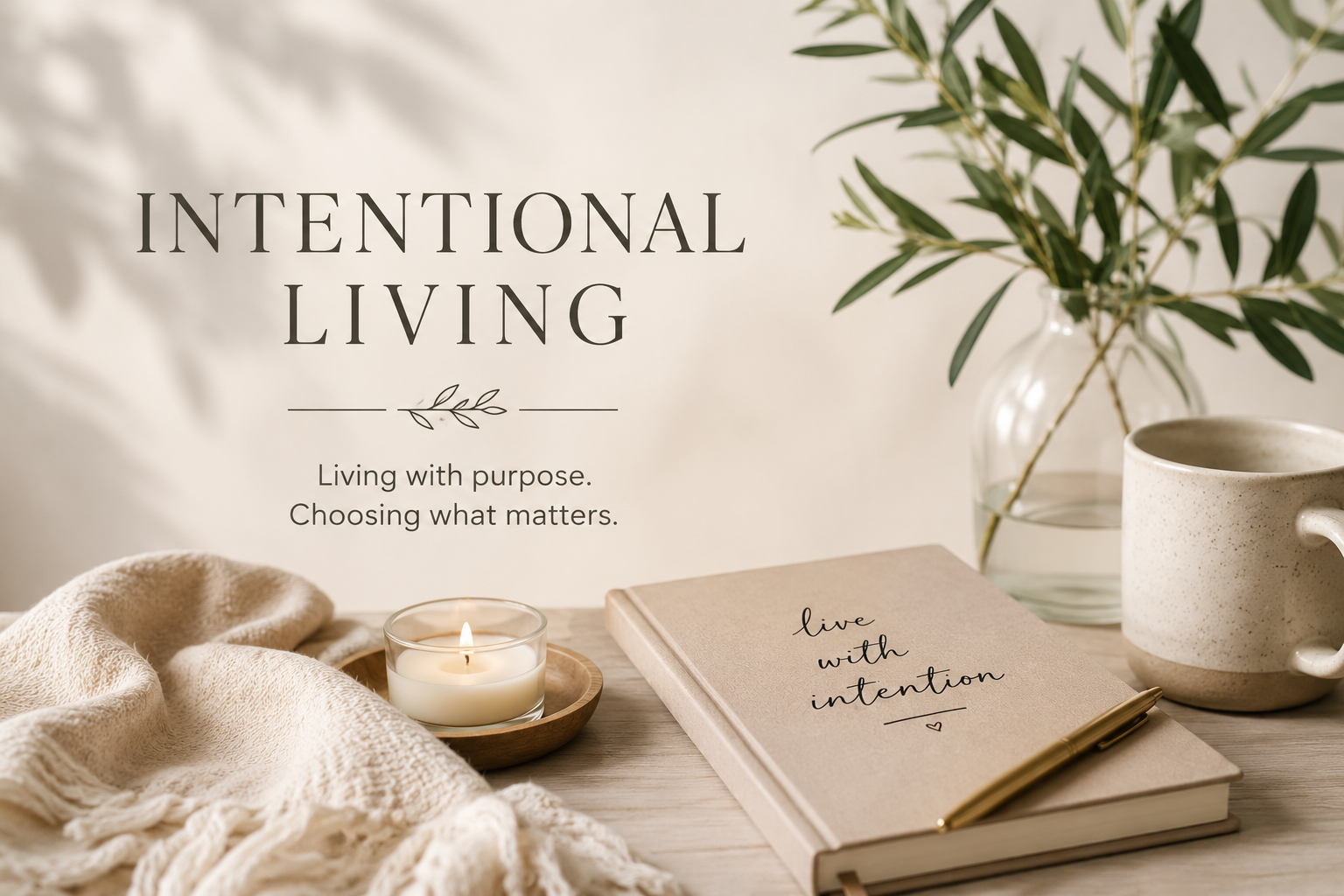

What Is Intentional Living?
You wake up. You check your phone before your feet hit the floor.
You move through the morning on muscle memory. Coffee. Commute. Inbox. Meetings.
When the day is done you fall into bed exhausted. And somewhere in the back of your mind, there’s this feeling. Like the day happened to you. Not for you. Not by you. It just happened.
Real talk, that feeling is not an accident. That’s what living on survival does.
The modern world is not set up for you to slow down and think. It’s set up to keep you moving. Keep you reacting. Keep you distracted.
Intentional living is what pushes back against all of that. It’s the practice of becoming aware of your choices, your habits, and your thoughts. So you can stop reacting to life and start actually living it.
This isn’t a trend. It’s not a productivity hack. It’s a decision to show up for yourself. On purpose. Every day.
“Between stimulus and response there is a space. In that space is our power to choose our response. In our response lies our growth and our freedom.”
— Viktor Frankl
What Intentional Living Actually Is (And What It Isn’t)
Let’s be real for a minute before we go any further. We need to get clear on what this actually means. Because a lot of people hear “intentional living” and think it’s some soft concept for people who have it all figured out.
It’s not that.
Intentional living is the practice of making conscious choices that align with your values. Instead of defaulting to habits, fear, or what other people expect from you.
It asks one question: Is this how I actually want to live or is this just what I’ve always done?
That question sounds simple. But when you start tracing your choices back to their origin. Like really sitting with it honestly, it can be quietly disruptive. It brings decisions you made based on survival years ago to the surface. These deserve are still running your life today. The career you defaulted into. The relationship patterns you inherited. The beliefs about your worth that were handed to you before you were old enough to question them.
| Intentional Living IS | Intentional Living IS NOT |
|---|---|
| ✓ Becoming aware of your patterns and habits | ✗ Rigid productivity or obsessive scheduling |
| ✓ Making choices from your values, not fear | ✗ Having everything figured out |
| ✓ Pausing before reacting emotionally | ✗ Being perfect or never falling into old patterns |
| ✓ Designing your environment with purpose | ✗ Only for people with unlimited time |
| ✓ Coming back to yourself after you drift — no shame | ✗ Toxic positivity or pretending life isn’t hard |
| ✓ A practice, not a destination | ✗ The same for every person |
Real Life Example
Think about the last time you said yes to something. A commitment. A relationship dynamic. A job task. Deep down, you wanted to say no. Not because you were forced to but because saying yes was just… easier. And in that moment, without realising it, you stopped living for yourself and started living for the expectation. That moment is exactly what intentional living addresses. It doesn’t ask you to have perfect boundaries. It asks you to notice, in real time, what’s happening and to start practising the pause.
What Living off Survival Is Actually Costing You
This isn’t a new concept. Philosophers and spiritual traditions have been pointing at it for centuries.
But the stakes have shifted. The forces working against conscious living have never been stronger. The world demands your attention at every turn. There is always pressure to keep up. And there is an entire culture that profits from your distraction.
At the end of the day, here is what happens when you stay on autopilot for too long:
You Lose Your Direction
Without intentional direction, we borrow someone else’s.
We follow the career path our family expected. We stay in cities that no longer fit. We let apps and social media decide what we watch, buy, and think about.
None of this is necessarily wrong. But when every decision is being made for you, you stop knowing what you actually want.
Years pass and you wake up living a life you never really chose.
You Stop Hearing Yourself
When everything around you is constantly demanding your attention notifications, other people’s opinions, the never-ending scroll it gets harder to hear yourself.
Over time, many people lose touch with what they enjoy. What matters to them. Who they are outside of their roles.
Intentional living gives you the space to come back to yourself. Your own voice. Your own wants. What feels true for you.
You Keep Repeating the Same Patterns
Perhaps the most quietly painful thing about living on autopilot is the loop.
The same relationship dynamic. The same self-sabotage right before a breakthrough. The same argument. The same avoidance. The same ceiling.
Real talk without awareness, we don’t just repeat our own patterns. We inherit and replay the patterns of the generations before us.
Related Reading: Understanding Generational Trauma Understanding how past patterns influence your present behaviour is a foundational step in intentional living. Discover how inherited cycles show up and how to begin interrupting them.
What Changes When You Start Living Intentionally
Now here’s the other side. Because it’s not all about what you lose when you don’t. It’s about what you gain when you do.
You Get Your Direction Back
When you start making choices on purpose, life stops feeling like something that’s happening to you.
You start waking up with a reason. You move through your day with clarity. The decisions you make start to feel like yours.
Not your family’s. Not social media’s. Yours.
You Actually Hear Yourself Again
When you slow down and check in, you start to remember what you actually like. What you actually want. Who you actually are when no one is watching.
That might sound small. But for a lot of people, it’s everything.
The Patterns Start to Break
Awareness is what interrupts the loop. Once you can see the pattern clearly, you have a choice. And that choice even if it’s small is where everything begins to shift.
The relationship dynamics change. The self-sabotage loses its grip. The ceiling starts to lift.
Real Life Example
One woman started a simple journaling habit five minutes every morning. Within three months she had left a job she’d been complaining about for two years, set a boundary with a family member she’d been afraid to confront, and started a business she’d been putting off for five. Not because journaling is magic. Because awareness is.
The 5 Core Principles of Intentional Living
Intentional living is not one big thing you do once. It’s a set of practices you come back to. Again and again.
These five principles are the foundation.
| 1 | Awareness You can only change what you can see. Awareness means becoming a compassionate observer of your own life. Your patterns. Your reactions. Your automatic thoughts. It’s not about judging yourself. It’s about looking clearly. |
| 2 | Choice Between stimulus and response lies a pause. Building that pause even for a second is where intentional living begins. Choice means recognising that you have agency. Even when it doesn’t feel like it. |
| 3 | Alignment Alignment is the ongoing check-in between what you say matters to you and how you actually spend your time. Your energy. Your attention. Misalignment is exhausting. Alignment even partial feels like relief. |
| 4 | Emotional Responsibility This is not about suppressing your emotions or performing like everything is fine. It means owning your emotional experience. Your feelings are data. Learning to work with them instead of reacting from them changes everything. |
| 5 | Consistency Over Perfection You will drift. You will fall back into old patterns. That’s not failure. The practice is simply coming back without drama, without self-punishment and choosing yourself again. |
Worth Remembering: You don’t have to do all of this at once. Start with the one area causing you the most friction. Awareness in one place has a way of spreading everywhere else.
How to Actually Practice Intentional Living
Let’s be real, understanding this concept is the easy part. The work is in the doing.
None of these practices require a retreat or a life overhaul. They just require honesty and repetition.
1. Journaling for Clarity
Journaling is not about documenting your day. It’s about getting your thoughts out of your head so you can actually see them.
When thoughts stay in your head, they loop. When you write them down, patterns emerge.
Try this: each morning, write three sentences about what you want to bring to the day. Not your to-do list. Your intention. At night, write one thing you noticed about yourself.
Over weeks, the data becomes undeniable.
Try This: “What am I avoiding today and what does that avoidance cost me?” is a journaling prompt that rarely fails to surface something important.
2. Slowing Down Decisions
Most reactive decisions come from discomfort. The discomfort of conflict. Of uncertainty. Of disappointing someone.
One of the most powerful habits you can build is the pause.
Before you say yes to something big, give yourself a waiting period. Before you send a charged message, sleep on it.
The goal is not paralysis. It’s giving yourself back the choice that reactive speed takes away.
3. Emotional Check-Ins
Most of us only notice how we’re feeling when it’s become urgent. When we snap. When we cry without knowing why. When we feel heavy and don’t know where it’s coming from.
Intentional living means checking in earlier.
Twice a day, pause for sixty seconds and ask: How am I actually doing right now? What am I carrying?
This isn’t therapy. It’s maintenance.
Real Life Example
You arrive at a dinner feeling irritable and take it out on the conversation. A 60-second check-in before you walked through the door “I’m actually carrying anxiety from work today” might have changed the whole evening.
4. Setting Boundaries as Self-Knowledge
Boundaries are not about shutting people out.
They are about knowing yourself well enough to protect what matters.
Most people struggle with boundaries not because they are selfish but because no one ever taught them that their own needs were worth protecting.
Intentional living asks you to identify your limits. Name them. And communicate them not as ultimatums, but as honest expressions of what you need to function.
5. Weekly Reflection Habits
A weekly reflection practice even fifteen minutes gives you a checkpoint before another week runs away with you.
Three questions are enough:
- What worked this week?
- What didn’t?
- What do I want to do differently?
The accumulation of these reflections over months is one of the most powerful tools for self-understanding that exists. You start to see your real patterns. Not the stories you tell yourself. What’s actually happening.
Digital Resources: The Intentional Living Toolkit Journaling prompts, reflection templates, and tools to support your intentional living practice designed to make the daily work simpler and more sustainable.
Who This Is For
Real talk, intentional living is not for people who have it all figured out. It’s for people in the thick of it.
This work tends to hit hardest for:
- People who feel stuck in a life that looks fine on paper but feels hollow or off
- People in transition between careers, relationships, life chapters who want to make the next move consciously
- People who keep repeating patterns they don’t want and are ready to understand why
- People who are breaking generational cycles and need a framework for building something new
- People who have read the books, done some of the work, but want deeper support
- People who are emotionally exhausted from a life that doesn’t quite feel like theirs
If you see yourself in any of that you’re already asking the right questions.
Coaching: Support for Deeper Transformation If you’re ready to move beyond reading about intentional living and start doing the work with support, explore what coaching looks like and whether it might be the right next step for you.
The Invitation
Here’s the truth about intentional living. It’s not a destination. There’s no graduation.
You don’t wake up one morning fully intentional and stay that way forever.
What you build slowly, imperfectly is a relationship with yourself that makes coming back easier.
You drift. Life makes sure of that. And then you notice. And then you return.
The gaps between the drifting and the returning get shorter. The self-judgment gets quieter. The clarity gets cleaner.
At the end of the day, that is the practice. That is what intentional living looks like in a real, complicated, human life.
You don’t need to rebuild your entire life to begin. You need to begin to begin.
Let Me Be Real With You For a Second
I’m not here to tell you how to live your life.
I’m just here to tell you to be intentional while living it. And to make sure you’re happy while you’re doing it.
Living an intentional life means having a reason for why you’re doing what you do. That’s it. That’s the whole thing.
But real talk way too often we live our lives the way others think we should. How to think. How to be. How to spend our time. What we should or shouldn’t say. What we should or shouldn’t wear. Whether we should or shouldn’t be on social media.
Here’s the thing though. If you intend to scroll for an hour because that’s what you want to do then that’s what you intend to do. It’s your life. It may not be the most productive use of your time, but it’s yours. And nobody gets to tell you differently.
People will always have opinions about how you should live. Most of the time those opinions are just their own upbringing talking. If you want to wake up at 12pm because that’s what works for you wake up at 12pm. If you stay up all night working on your craft instead of waking up at 5am to work for someone else that’s intentional. You’re building the life you want for yourself.
I’m not saying ignore advice especially when it’s coming from a good place. I’m saying don’t let anyone else’s blueprint become your ceiling.
Do what feels right for you. Do it with purpose. Do it with awareness.
And while you’re living that intentional life make sure your intentions are pure in everything you do. No matter what.
Ready to Start Living on Your Own Terms?
Whether you need tools, community, or personalized support there’s a next step that fits where you are right now.
- Work With Me — 1:1 coaching for deeper transformation
- Free Resources — Tools and prompts to get started today
- Digital Products — Self-paced tools for intentional living

Tools and wisdom for those ready to break cycles, heal intentionally, and build a life that’s fully theirs.
© 2025 Natural Butee. All rights reserved. — Designed with intention.
Privacy Policy | Terms & Conditions| Accessibility Statement